mirror of
https://github.com/hyperledger/fabric-samples.git
synced 2026-06-17 15:35:09 +00:00
 a299e18e26
* Import Full Stack Asset Transfer Guide at commit fb554befdbbeff9e69159b54fce0b811603f29c7

Signed-off-by: Josh Kneubuhl <jkneubuh@us.ibm.com>

* Update the workshop with a new WORKSHOP_PATH under fabric-samples

Signed-off-by: Josh Kneubuhl <jkneubuh@us.ibm.com>

* Update the workshop with a new WORKSHOP_PATH under fabric-samples

Signed-off-by: Josh Kneubuhl <jkneubuh@us.ibm.com>

* missed a .git ignored directory on add

Signed-off-by: Josh Kneubuhl <jkneubuh@us.ibm.com>

* Updates to run the workshop on the Apple M1

Signed-off-by: Josh Kneubuhl <jkneubuh@us.ibm.com>

* Workaround for https://github.com/eslint/eslint/issues/15299 in the contract tslinter

Signed-off-by: Josh Kneubuhl <jkneubuh@us.ibm.com>

* Build an arch-specific CC images on M1

Signed-off-by: Josh Kneubuhl <jkneubuh@us.ibm.com>

* empty commit - force a build

Signed-off-by: Josh Kneubuhl <jkneubuh@us.ibm.com>

* revert an accidental commit that was building the top-level asset-transfer as arm64

Signed-off-by: Josh Kneubuhl <jkneubuh@us.ibm.com>

Signed-off-by: Josh Kneubuhl <jkneubuh@us.ibm.com>
1.7 KiB
1.7 KiB
Deploy a Kubernetes Cluster
PREV: Setup <==> NEXT: Deploy a Fabric Network
With cloud-native Fabric, all the components can run directly on your development workstation. In this exercise, you will configure:
-
A local kind cluster, running Kubernetes in Docker.
-
A local Ingress controller, routing traffic into the cluster at the
*.localho.stvirtual DNS domain. -
A local Container Registry, allowing you to upload chaincode Docker images to the cluster.
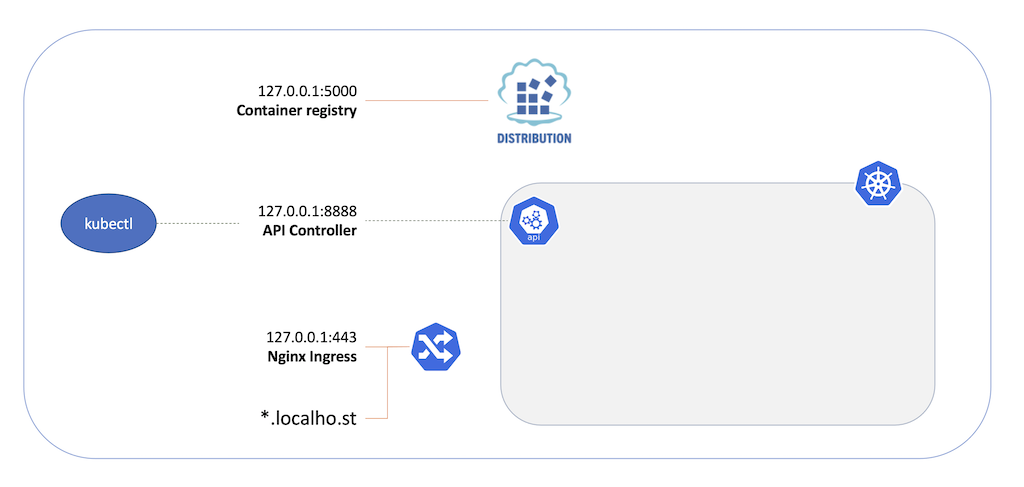
Ready?
just check-setup
Kubernetes IN Docker (KIND)
- Set the cluster ingress domain and target k8s namespace. The
localho.stdomain is a public DNS wildcard resolver mapping*.localho.stto 127.0.0.1.
export WORKSHOP_INGRESS_DOMAIN=localho.st
export WORKSHOP_NAMESPACE=test-network
- Create a kind cluster, Nginx ingress, and local container registry:
just kind
- Open a new terminal window and observe the target namespace:
# KIND will set the current kubectl context in ~/.kube/config
kubectl cluster-info

k9s -n test-network
Trouble?
- Run KIND on a multipass VM on your local system
- Run KIND on an EC2 instance at AWS
Take it Further:
- Run the workshop on an IKS or EKS Cloud Kubernetes cluster.
- Run the workshop on an AWS VM, using your AWS account and an EC2 #cloud-config.