67d3c65847
Instead of using the Fabric and Fabric CA three digit version (2.4.3), utilize the two digit version (2.4). Each time a Fabric/FabricCA release is pushed to dockerhub the two digit version tag is updated. This approach simplifies maintenance so that scripts don't have to be updated for every third digit release. Signed-off-by: David Enyeart <enyeart@us.ibm.com> |
||
|---|---|---|
| .. | ||
| images | ||
| APPLICATIONS.md | ||
| CA.md | ||
| CHAINCODE.md | ||
| CHANNELS.md | ||
| HIGH_AVAILABILITY.md | ||
| KUBERNETES.md | ||
| README.md | ||
| TEST_NETWORK.md | ||
Kubernetes Test Network
Starting in release 2.0, Hyperledger introduced the test-network to serve as both an accelerator and learning resource for running Fabric networks. In addition to providing a study guide for operational patterns, the test-network provided a baseline environment for members of the Fabric community to quickly get up to speed with a working, local system, author smart contracts, and develop simple blockchain applications.
As a supplement to the docker-compose based test-network, this guide presents an equivalent Fabric network suitable for running sample applications and chaincode, developing Gateway and Chaincode-as-a-Service applications, and harmonizing CI and deployment flows with a unified container framework - Kubernetes.
Similar to Fabric, Kubernetes introduces a steep learning curve and presents a dizzying array of operational
flexibility. In this guide, we'll outline the design considerations in the ./network
scripts, provide a supplement to the Fabric CA Deployment Guide,
and build up to a reference model for realistic production deployments on Kubernetes.
Ahoy!
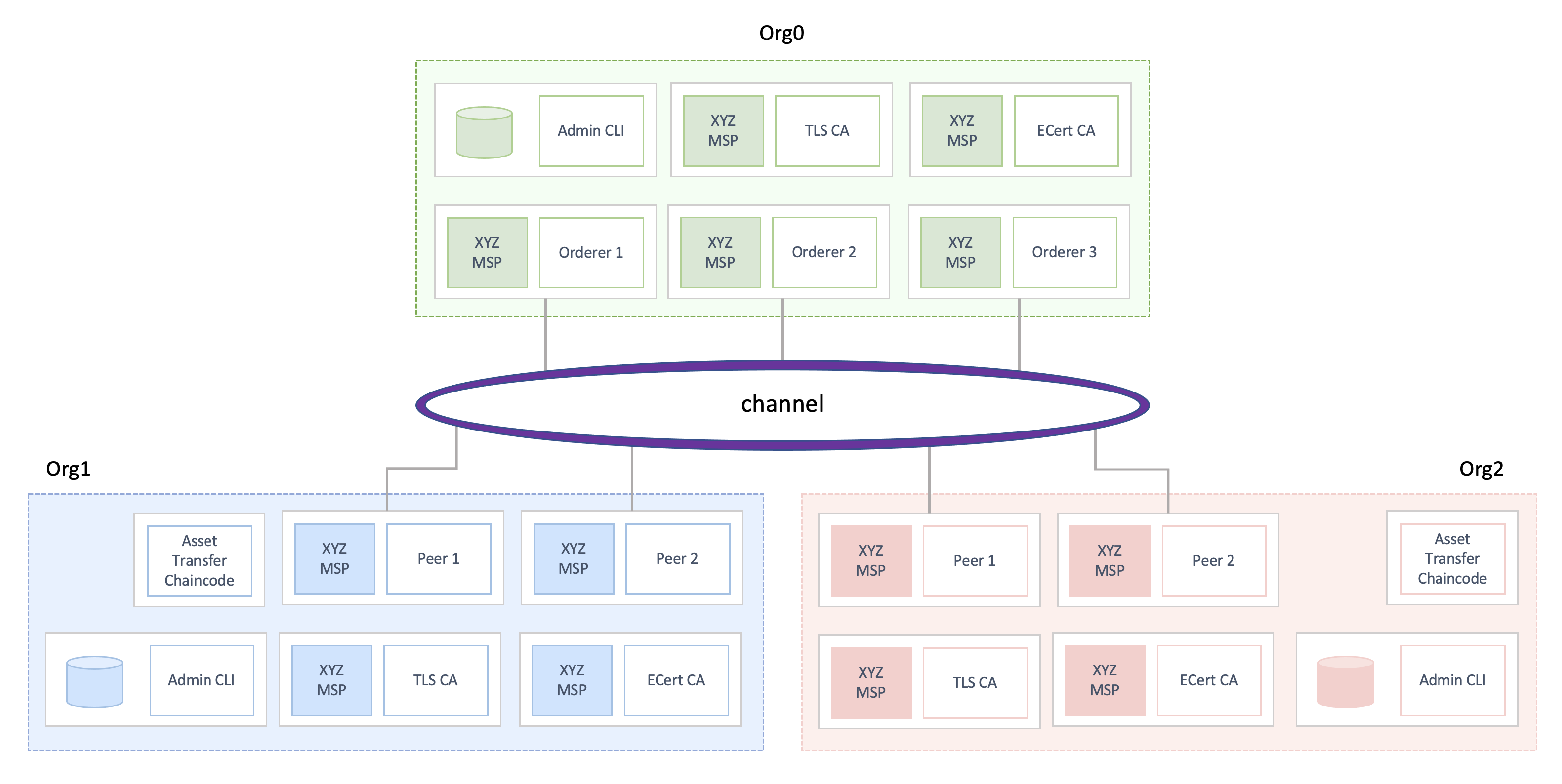
Network Topology
The Kube test network establishes as consortium among a dedicated ordering organization and two peer organizations. Participation in the network is managed over a channel, and transactions are committed to the blockchain ledgers by invoking the asset-transfer-basic Chaincode-as-a-Service running in a shared Kubernetes namespace.